
English 
T: +86-156-0511-1716
E: hp018@hpcbkj.com
E: hp018@hpcbkj.com
In Fangong Industrial Park, Dongtai Town, Dongtai City


Stationary Shaft Mode:
Compressed air inflates the rubber sleeve, creating an immediate barrier against seawater pushing along the shaft axis.
Operating Mode:
As the shaft spins:
Spring pressure keeps dynamic/static rings tightly engaged
This rotating seal face blocks radial seawater leakage
O-rings seal secondary leakage paths
Pressure Management:
Controlled air pressure in the tube balances external seawater pressure, preventing leaks caused by pressure differentials.
| Quantity: | |
|---|---|


The HPSD/HPSD-L Water-Lubricated Stern Shaft Seal Device is a critical component for marine stern shaft systems, designed to prevent seawater intrusion while ensuring smooth operation in water-lubricated environments. It integrates reliable sealing performance with adaptive design, making it a preferred choice for various marine vessels.
Dual-Mode Sealing Protection: Automatically switches between pneumatic sealing (when the shaft is stationary) and dynamic mechanical sealing (when the shaft is rotating), eliminating seawater leakage risks in all operating states.
Multi-Layer Leakage Prevention: Equipped with precision-machined static/dynamic rings, high-elasticity springs, and multi-position O-rings to block radial/axial leakage paths comprehensively.
Eco-Friendly & Regulation-Compliant: Minimizes environmental impact, meeting strict marine environmental standards for eco-sensitive areas (e.g., offshore wind farms, research waters).
Customizable Dimensions: Supports tailor-made production based on user-provided shaft sizes, ensuring perfect compatibility with different vessel types.
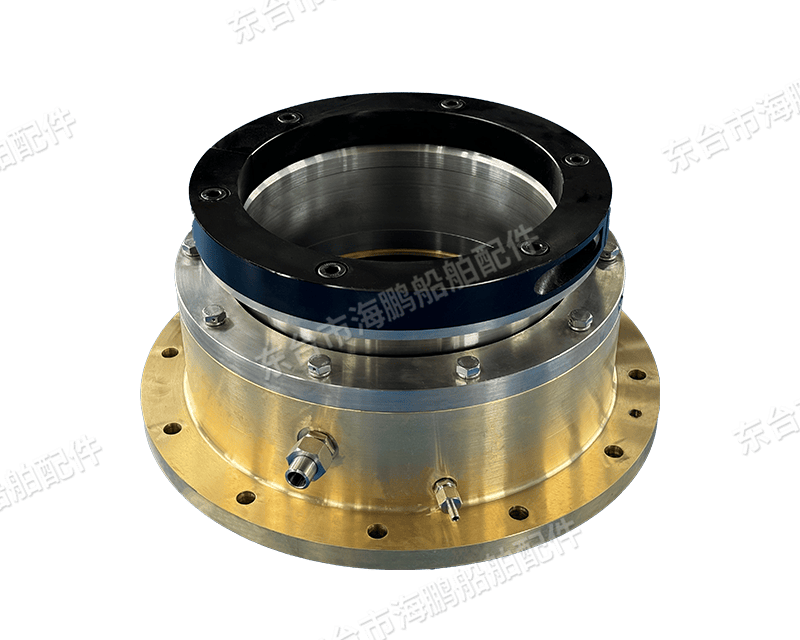
Robust Structural Design: The base (seat) is bolted to the hull or stern tube for stable installation; the pneumatic tube is internally reinforced to resist pressure deformation.
Vibration Compensation: High-performance springs maintain constant pressure between static and dynamic rings, offsetting shaft vibration and axial movement.
Heat Management: A dedicated cooling port circulates water to reduce heat generated by shaft rotation, prolonging component lifespan.
Pressure Balance Control: Adjusts internal air pressure to match external seawater pressure, avoiding leakage caused by pressure differentials.
Inland Waterways (Rivers/Canals): Handles mild water level fluctuations and calm water conditions, providing long-term reliable sealing for cargo ships and passenger vessels.
Coastal Vessels (Fishing Boats/Yachts): Withstands wave and tide impacts, effectively blocking seawater ingress to protect stern shaft bearings and reduce maintenance frequency.
Specialized Offshore Vessels (Wind Turbine Installers/Research Ships): Meets eco-friendly requirements, avoids oil pollution, and complies with strict offshore operation regulations.
Seat: The foundation component that fixes and aligns all sealing parts, ensuring structural stability under long-term operation.
Pneumatic Tube: Inflates with compressed air when the shaft stops, forming an instant axial barrier against seawater; internal reinforcement enhances pressure resistance.
Seal Ring Assembly:
Static Ring: Fixed to the seat, with a precision-ground surface for tight fitting.
Dynamic Ring: Rotates synchronously with the shaft via the dynamic ring seat; its contact with the static ring forms the primary seal.
Spring: Provides continuous pressure to the dynamic ring, compensating for wear and shaft displacement.
O-Ring: Installed at critical joints (e.g., seat-static ring interface, bushing connections) to block secondary leakage.
Connections:
Inflation Port: Supplies compressed air to the pneumatic tube.
Cooling Port: Circulates cooling water to control shaft temperature.
Stationary Shaft Mode: Compressed air inflates the rubber sleeve of the pneumatic tube, creating a physical barrier to prevent axial seawater intrusion.
Operating Mode: As the shaft rotates, the spring pushes the dynamic ring to maintain tight contact with the static ring, blocking radial seawater leakage; O-rings seal auxiliary paths.
Pressure Management: Controlled air pressure in the pneumatic tube balances external seawater pressure, ensuring stable sealing performance.
Customization Service: Designs and manufactures products according to user-provided shaft dimensions, drawings, or operation requirements.
Technical Documentation: Provides detailed installation manuals, 2D/3D drawings, and material certificates for easy integration into vessel systems.
On-Site Support: Dispatches technicians for on-site installation guidance, debugging, and performance testing if needed.
After-Sales Maintenance: Offers regular maintenance reminders, spare parts supply (e.g., O-rings, dynamic rings), and fault troubleshooting services.


